


Giving talks matter. A lot. A bad talk can cost you your dream job. A good talk can convince someone to change their entire research career.
Good talks make people pay attention, and keeping people’s attention is hard. I should know. As a kid, I was constantly rocking on my chair, talking in class, and arriving late. As an adult, when I sit in talks—even good talks—my attention is like a laser pointer taped to one of those inflatable tube men outside a car dealership.
Of course, you might be different. You might be like my wife, Kristen Lindquist, who has the attentional focus of the Death Star laser. She finishes big books with ease. She gets to the end of an 11-season TV show. She can sit down and immediately start working.
I leave 99% of books unfinished. After the 3rd episode in a series, I lose interest. I only start writing after picking the right soundtrack, getting the right snack prepped, and then checking a dozen things.
But my poor attention span is why you should trust me about talks: I know what makes for compelling talks. If I’m paying attention, I think “Wow, what’s going on here?” If I’m not paying attention, I’m wondering “What’s the problem here?”
So what does make for better talks? I wrote a NEW PAPER on it, and this Substack is the TL;DR.
Easy Don’ts
It should be obvious what you shouldn’t do. Don’t have lime green slides. Don’t use spinning animations. Don’t write in Comic Sans. Don’t just read a journal article and pretend it’s a talk. Don’t curl into yourself, as if you’re ashamed to be speaking. And don’t summon the spirit of your late advisor through an Ouija board (I recently broke this rule).
Four Essential “Do’s”
WHY should people listen: Capture attention with societal importance and a big question.
WHAT is the story: Give people a story; a coherent quest.
HOW do you know what you found: Provide concrete details when necessary.
WOW you really surprised me: Control attention.
Each of these principles are supported by psychology and are drawn from fields where losing attention is career death: journalism (Why), fiction/mythology (What), instructional videos (How), stage magic (Wow).
WHY: Give people a reason to listen, and keep giving it.
In journalism, you have less than 5 seconds to capture someone’s attention. People read the first sentence and then can decide to stop reading. So you need to OPEN BIG.
Right away, people need to know why to care. And for talks, that means telling them that this matters for the real world and their lives. Consider two openings:
“Scholars have long debated about the nature of personal connection and how specifically to characterize the process by which social bonds are created.”
or
“50% of Americans are lonely and it’s killing them with deaths of despair. Feeling lonely is as dangerous as smoking 15 cigarettes a day. Even many people in this very room wish they had more connections. But how do you make friends?! It seems like a secret.”
The second one is obviously more enticing. Then, once you make people care about the problem, make them care about the big idea behind your work: “Creating social connection is perhaps the most powerful human need, but for 50 years, science has gotten it wrong!”
Notice that I’m being EXPLICIT, so that people don’t have to guess why they should care. The first rule of journalism is “Don’t bury the lede,”—so open with the most impactful reason to care.
It’s not enough to just make people care at the beginning. You have to keep refreshing their motivation. As I write in the paper:
The urgency behind your science needs to never be far away, like rats in the walls of your audiences’ minds, chewing at the insulation.
Giving your audience a reason to care will keep them listening.
WHAT: Tell a compelling narrative, a quest demanding an answer
A good talk is not just a series of logically connecting slides, just like a good fiction book is not a series of logically connecting paragraphs. You will never see this blurb on a book cover: “This New York Times Bestseller is logically coherent!”
A talk needs to tell a story, a quest for knowledge with challenges and eventual victory. Stories can have different plots, but the most timeless is the Hero’s Journey (we’ve done some work on this). In a hero’s journey, the protagonist (you, the speaker), must venture out to learn something crucial about the world and then bring back that knowledge. They must go through a dark forest of ignorance and overcome challenges.
In talks, these challenges can be rival theories, methodological hurdles, scientific confusion in the field, etc—your story is how you navigated these challenges to come to your conclusion.
The best fantasy books often have a literal map: You open the Lord of the Rings and are immediately shown a sketch of Middle Earth. Talks should have maps so that your audience knows where they are going, where they are, and where they have been. Narratives connect past, present and future. Without a narrative and a map, the audience feels like they are wandering aimlessly through the woods, constantly thinking “What’s going on?”
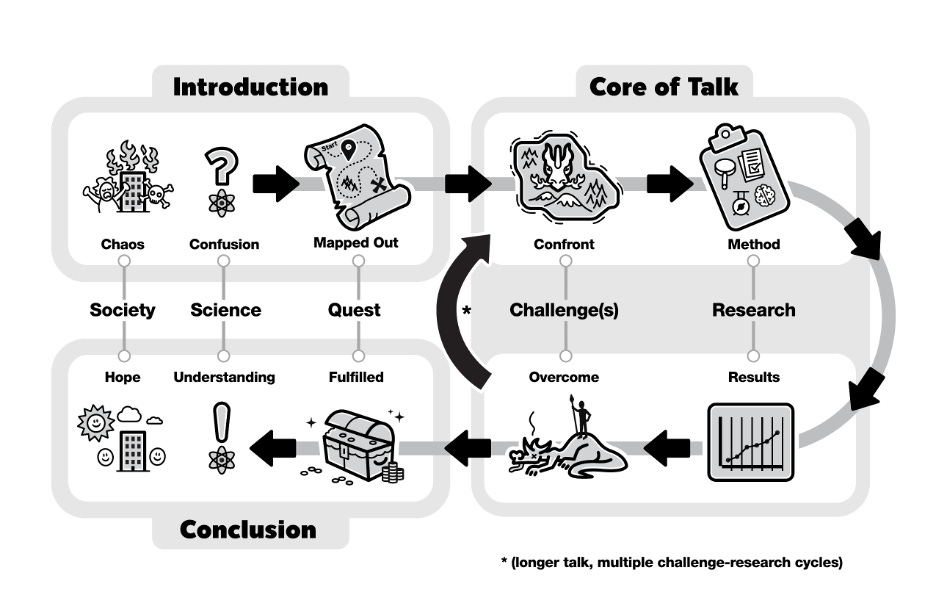
Also consider which pieces are a necessary part of your talk’s journey. In the best stories, the hero seldom takes a detour to do something irrelevant. Luke Skywalker doesn’t pause to learn double-entry accounting, Harry Potter doesn’t take a day to compare different hemorrhoid ointments. I repeat to my students: Narrative reigns supreme. Every slide exists to advance the story, otherwise your audience will get bored or—worse—confused about why you’re discussing something.
How: (More than) two easy steps
There’s a subreddit called “r/restofthefuckingowl”. It’s named after these instructions about how to draw an owl. Just two easy steps!
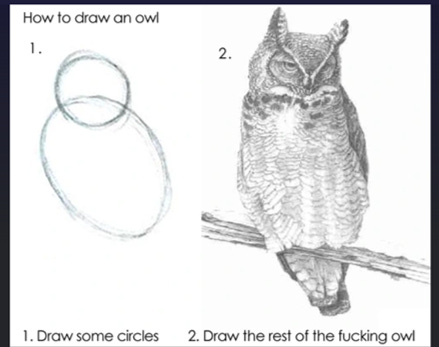
Don’t make your talk–especially your technical details—like the rest of the fucking owl. When you are exploring difficult hard-to-learn topics, you need the how. Designers of instructional videos (and IKEA and Lego manuals) know that you need to provide steps in concrete details.
Providing the HOW often means taking a “beginners mind” where you imagine what it’s like to not know anything about your topic.
The HOW is also important when you’re trying to convince people of something. They want to know how you arrived at a conclusion. When you don’t, people don’t get convinced. They can also get pissed.
From the paper:
“One remarkable study (from my advisor Dan Wegner) used a special Ouija board—modified in a neat way—and another study used an improv game involving large white smocks that ended, startlingly, with some self-harm (Wegner & Wheatley, 1999; Wegner et al., 2004). Because these methods were unique in special ways, they yielded powerful results.
But I’m not going to tell you how these methods were special, or about the specific results.
Notice your thoughts right now. You want to know: How was the Ouija board modified? What self-harm? Why the smocks? You’re annoyed because I stymied your urge for concrete knowledge. I just told you rather than showed you. That irritation at vague handwaving is what you want to avoid in your own talks. Every time you assert a conclusion without showing the audience how you got there, you create frustration.”
So when you are walking through your method or results, do so with enough detail so people know exactly what happened. Provide your survey items, show your scatterplot, identify every Greek term in your equation, describe how you built your anti-matter containment device. If it’s too complicated to explain…then don’t introduce the concept in the first place. Stephen Hawking explained the nature of time and the universe, so you can probably unpack your experimental method or statistical analyses with enough detail that people can understand.
Wow: Don’t let your audience time travel.
Stage magicians excel at the WOW. When they pull that card from a hat, they first build up to it. They control your attention. They set-up your expectations so the reveal comes as a surprise, a WOW moment.
In a talk, a WOW moment is when you either get surprised or when your intuitions get cunningly confirmed. It usually takes some forethought, and matter most when presenting your data (or the punchline).
-You set up what people might expect given their prior knowledge.
-Then you introduce the frame for what you’re about to present. For data, this is probably the axes of your graph. Be explicit when orienting your audience: On the X axis is bacon consumption. On the Y axis is winning the lottery.
-Then, being explicit again, directly address expectations: “You might expect no relationship between eating BLTs and making $$$.”
-Then WOW, reveal the data: “There’s an almost perfect correlation between bacon and winning the lottery, what’s going on here?!”
The bigger idea behind WOW is that you have to control people’s attention. And this means being careful about what you present—and WHEN—because people will just focus on the most attention-grabbing thing on your slides, ignoring everything else. I’ll give you an example.
In undergrad, I had two friends that were “old” (e.g., 25) and married. They owned two of those little fluffy white dogs with underbites. We went over to their house for drinks and had a conversation in their living room. But here’s the thing: there was dog shit everywhere. They allowed their dogs to poop on the carpet in the living room and didn’t feel the need to clean it up. Thankfully it didn’t smell too bad, but still…
And while we were sitting surrounded by poop, this couple tried to talk about interesting things we had learned in psychology class and current events. But obviously I couldn’t focus because, obviously.
Don’t be this couple. Don’t put something on the screen that people can’t look away from and then talk about something else. This might even be your cool data that you put on the slide too early.
Audiences are sneaky. The second you put a slide up, their eyes race to the bottom to read your conclusion before you’ve finished discussing the first bullet point. Or they continue to read your point from 10 minutes ago as you keep talking. Either way, they’re not with you, they’re mentally time traveling.
The fix is to control not just what the audience sees, but when they see it. Reveal slide content as you go, and make sure that—when you reveal it—people have clear expectations about what they will see. Only then will people go WOW.
One more thing: Murder your darlings.
You know that slide you made, with the really cool thing that’s not super connected to your story. Kill it.
You know that neat project you did a while ago that you want to make sure your audience hears about but it’s not super relevant. Cut it.
Conclusion
Giving talks is stressful. Hopefully these tips give you a bit more guidance. If you want more information, check out the paper, which also has 6 key problems and how to fix them.
But before you go, three important things are worth mentioning.
One, I’m just one person. If you disagree with my advice, great. That means that you both care enough to give a compelling talk and you’ve thought about it enough to disagree.
Two, everyone gets better with practice. The first time I talked at a conference, my slides sucked and I went into a fugue state. I remembered walking to the stage and then I remembered when someone asked me a question at the end. Between those points—stress-induced amnesia. It’s better now but I still get nervous.
Three, I still get distracted, and you might too. Even interesting things can lose people’s attention, and that’s okay. Even important things are sometimes
The rest of the f*$%ing owl! More than two easy steps! No kidding.
Great stuff Kurt and Helen! I'm sharing with PhD students in my writing/presentation skills class now!