


Ugh: Friends, and their Need for Empathy
You’re back home for Thanksgiving, talking to a friend you haven’t seen in a while, and suddenly they’re spilling all of their problems without asking how you’ve been.
Friends can be kind of annoying. They are constantly doing things—getting married, having breakups, becoming parents, dating someone you told them not to date and then calling you when disaster strikes.
Fortunately for those of us who have become the unofficial “therapist friend,” our tech overlords created LLMs, so now anyone with a smartphone can go cry to ChatGPT.
For years, the big debate has been whether AI will steal our jobs. (Watch out mathematicians!!) But new research from our lab says that AI will instead steal our friends. Or really, AI will make us care less about friends.
The question we wondered about: When we know someone has sought empathy from ChatGPT about their problems, would we then show them less empathy? The answer is yes: We ask them fewer questions and we get worse at reading their emotional expressions.
Maybe the reason we feel like nobody is listening anymore is because we are actually listening less.
(This is our first article in a trilogy about AI and the human soul. First, we look at empathy–how AI is making us ignore the emotions of the suffering. Next, we’re looking at Amish phone booths, Shabbat, and how our ancient rules are holding up against AI. Last, we’re looking at authenticity, i.e., if ChatGPT writes your wedding vows or paints your final project for studio art, is it really yours?)
If You’re Crying to ChatGPT, Don’t Tell Your Friends
We used to cry only to our friends and family–or by ourselves–but now we never have to be alone. We can be vulnerable with chatbots, which is one reason why AI has been so efficient at infiltrating our daily lives and friendships.
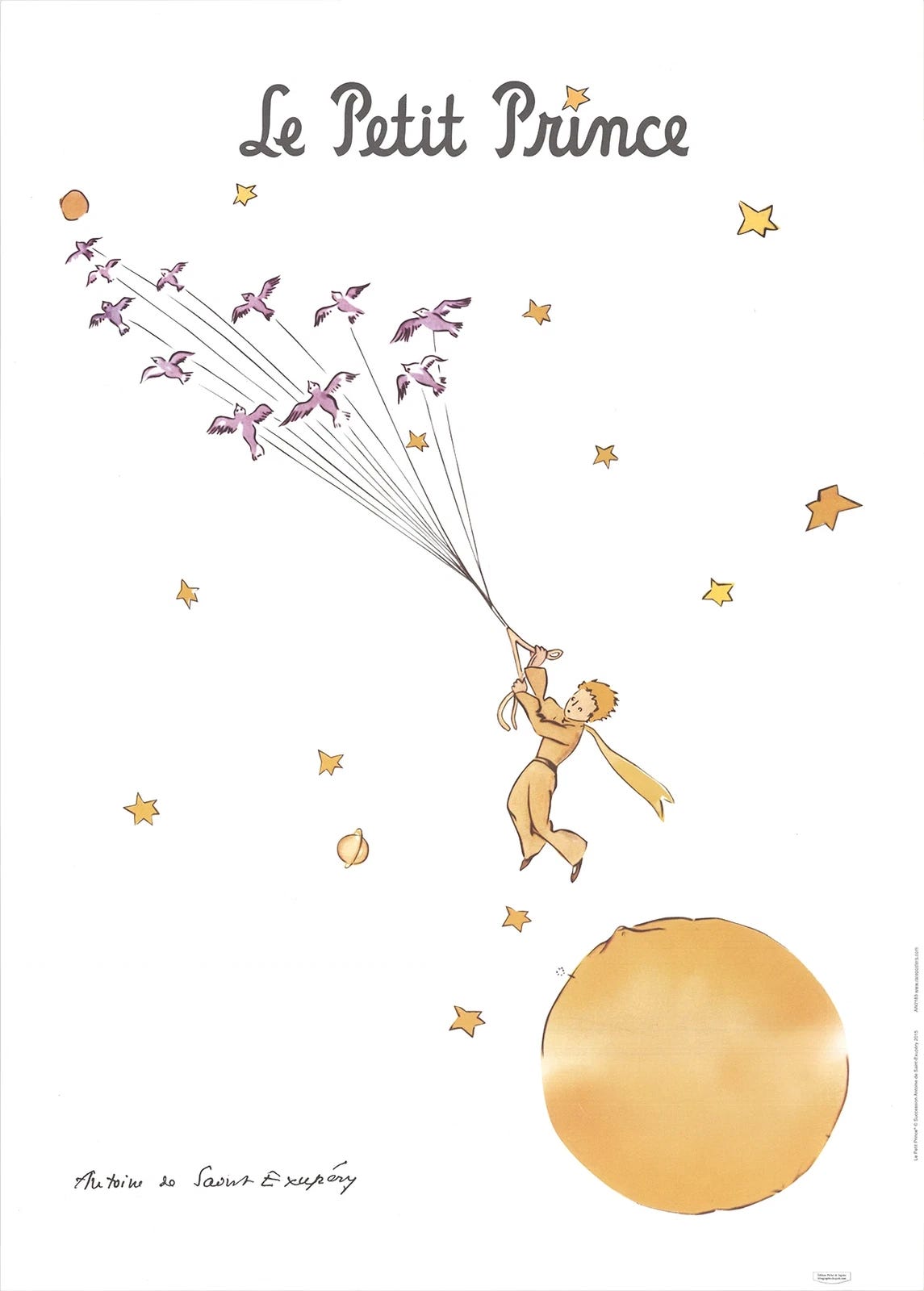
In my less proud moments, I (Luke) have sent selfies to ChatGPT, requesting it to generate images of what I’d look like with 1) hairstyles I am far too timid to ever attempt (frosted-tipped, curls of chaos), and 2) enormous face tattoos that seem equally unlikely (like the Little Prince flying with birds)!
Aside from the fact that those are objectively ridiculous, the main thing I notice after I close the app or web browser is a sense of shame. I felt contaminated for trusting in AI, for treating it as a friend. I shared an embarrassing, inner part of myself with a training model made to get Big Tech rich. And never is this icky feeling more pronounced than when I ask ChatGPT questions about my relationships with other people.
But I know I’m not alone. My friends are almost certainly confiding in AI, and (statistically speaking) you are too. Therapy and companionship are now actually the number one use of generative AI.
In our recent paper, Madhulika Shastry and Kurt ran four experiments to see what happens when you find out someone else has been sharing their problems with ChatGPT, before coming to you. And the results are in: when we hear an acquaintance has gotten emotional support from AI, we start withdrawing our own support, because we think (often implicitly) that AI is capable enough to handle it. We call this empathic offloading. As in, we are offloading the labor of empathy to the robots.
Empathic Offloading
When you think of empathy, the first words that come to mind are probably not “labor” or “work”. But consider the parallels between showing someone empathy and a laborious task, like doing sets of squats while listening to a political podcast. They both:
Require a significant amount of attention.
Can leave us mentally and emotionally tired.
Are often revered when people can do them at an extraordinary level, i.e. Mother Teresa or strongman Eddie Hall.
But I am not Mother Teresa or Eddie Hall (despite how wonderful both of those sound as Halloween costumes/hairstyle icons). Whether the labor is helping the vulnerable or kettlebell swings, sometimes I like to take the easy way out. We all do.
We humans try to save effort (read: are lazy), and sometimes that’s a good thing. Farmers use tractors instead of hand-going fields, and we use computer programs to file our taxes. Like farming and filing, empathy is cognitively and emotionally hard work, but should we want to save ourselves the hard work of offloading empathy?
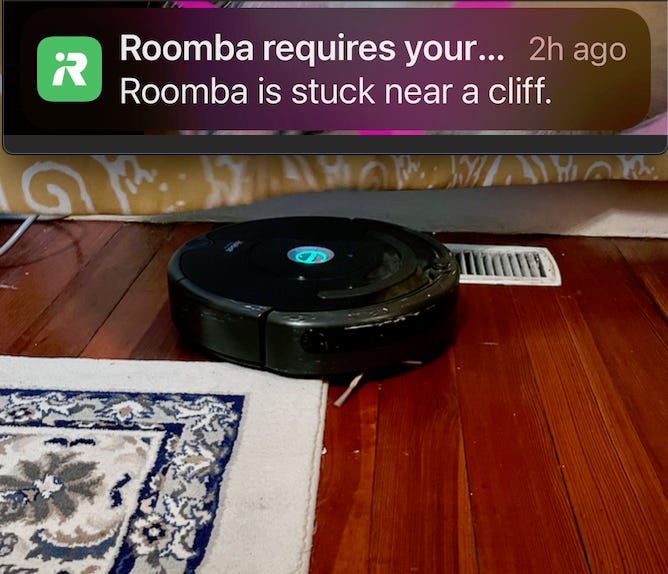
If empathy is labor, then empathic offloading is basically the emotional equivalent of me buying a Roomba. The theory is that I save myself the work of sweeping and use that time for something more meaningful. (In practice, I actually spend much of that time pulling the stuck Roomba out from under my couch while it screams at me.)
But friendship is not sweeping! Friendship is about work but it’s not a chore. Unlike a clean floor, there is no clear end goal of friendship (no matter what the maniacal manipulators among us might think). When we put in the work of interpersonal relationships, we receive the social bonding we need, as well as shared experience, and all those intangible joys and pains that blossom out of human connection…that stuff they keep making art about.
This is a fundamental difference between emotional work and emotional labor.
Emotional labor is an office receptionist smiling at you. It’s the waiter laughing at your father’s horrible joke. These folks are being paid (or tipped) on account of how well they can manage their emotions to make yours profitable. But emotional work is different: it’s the unpaid effort of maintaining our relationships. At the same time, emotional work is valuable because it requires time and effort. (Marx never said listening to your friends was exploitation by the ruling class.)
But the upsurge in AI chatbots has given us the craven opportunity to offload the emotional work. And that’s exactly what we’re doing.
AI Is Making You A Worse Friend
In our study, we had 743 participants read about an acquaintance, J.S., who was having a “tough time”.
A third of these participants were told that J.S. received no emotional support during his difficult week, another third was told that J.S. talked to another person about his woes, and the remaining third was told that J.S. talked to the robot king itself, ChatGPT.
We then asked participants to write 5 questions that they’d like to ask J.S.
We took a look at the results and noticed two kinds of responses.
One kind of questions we saw were questions of concern:
“What is bothering you?”
“What happened?”
And another kind were helping questions:
“Do you want me to come over?”
“Is there anything I can do?”
Questions of concern help us understand another’s problems and make them feel heard. Helping questions, on the other hand, make their problem (at least partly) our problem. The listener takes on the weight of the issue and suffers with them.
Participants who were told that J.S. had gone to ChatGPT asked about 29 percent fewer helping questions than people in the other groups. This means that just knowing someone else gets help from AI may cause us to ask fewer helping questions!
We then showed participants photos from the Reading the Mind in the Eyes Test (RMET), and told participants:
“Imagine this is J.S., who told you they have been having a tough time lately.”
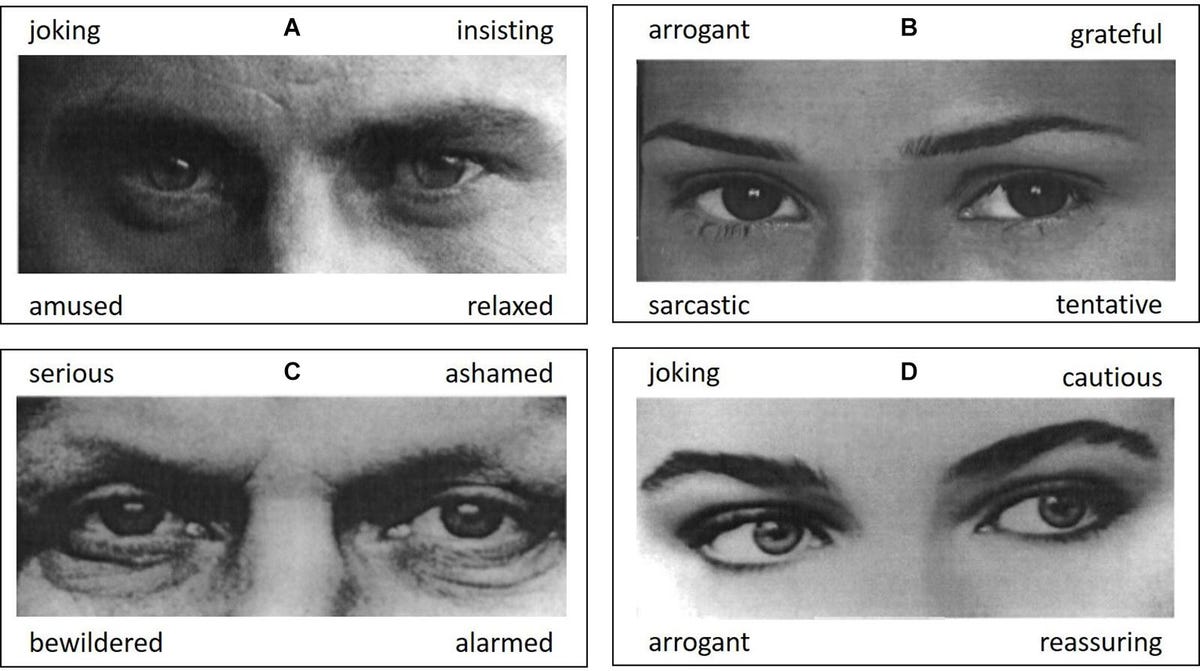
The participants who were told that J.S. went to ChatGPT for emotional support scored the lowest average accuracy on the (RMET) across all three groups.
Knowing someone has confided in AI changes how closely we pay attention to them. Somewhere in the back of our minds, we may think: Well, they’re getting empathy elsewhere.
This pattern repeated across all our tests.
In another task, we gave participants a word cloud containing 18 empathetic words and 26 indifferent words. Participants chose fewer empathetic words and more indifferent words when they knew the other person had received support from ChatGPT. But what I found most mind-blowing was this didn’t happen when the person had seen a therapist. People chose about as many empathetic words for someone who’d visited a therapist as for someone who’d received no support at all! Which is quite refreshing news: you can chat to your friends about therapy as much as you want (for now) and not worry they’ll offload all the empathy to the shrink.
Also, when we gave participants real news headlines about AI’s capacity for empathy, the participants self-reported feeling more willing to offload their personal empathetic responsibilities to AI.
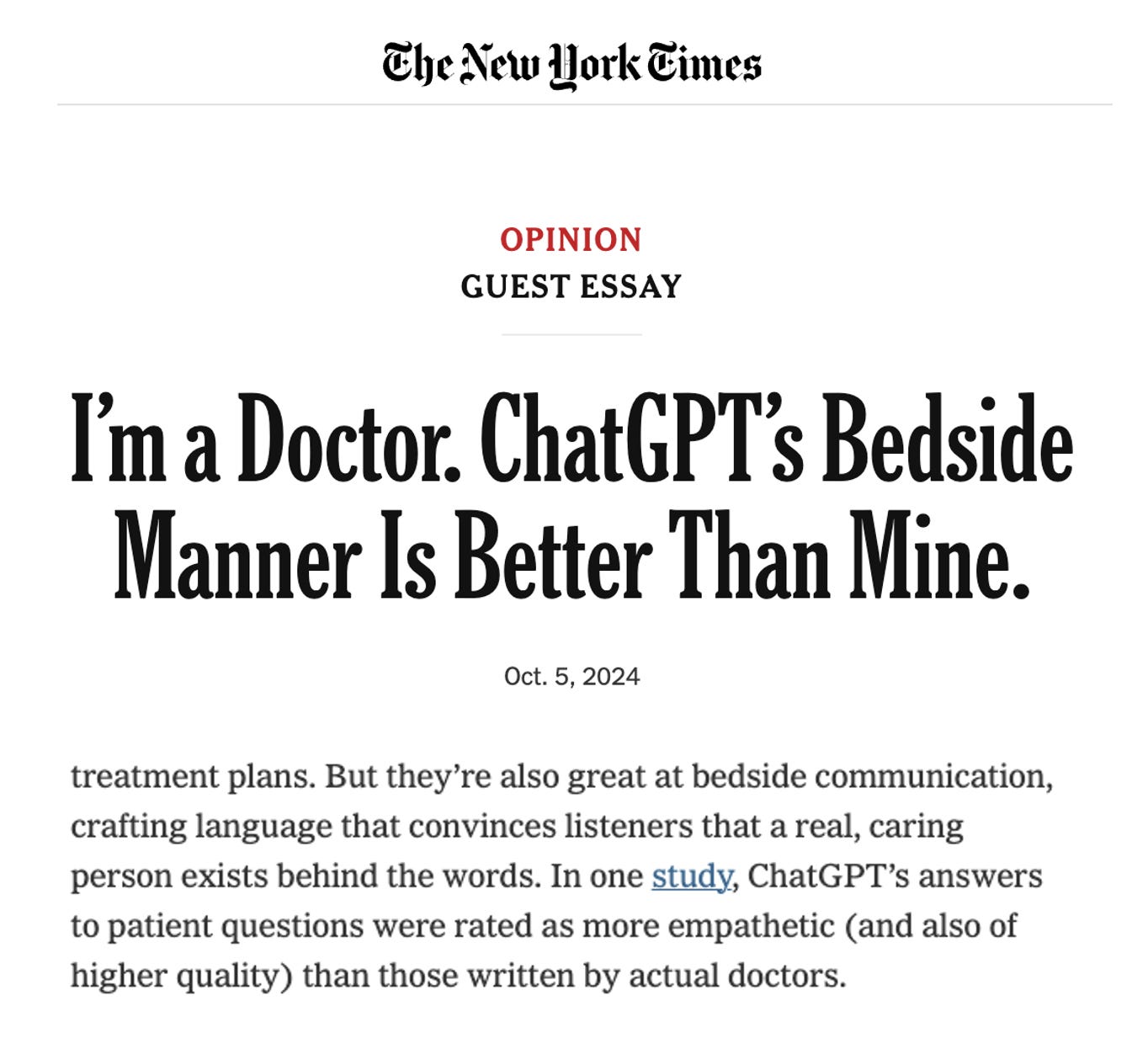
In that study, an individual who went to AI for support was:
“perceived as more weird, antisocial, and desperate when they went to AI compared to friends and therapists”
We even view people through a negative lens once we hear about their LLM support system.
Nobody appears to be consciously thinking, my husband got ChatGPT Plus, so I’m finally off the hook for asking about his day. Instead, our perception of the person changes in more implicit and insidious ways. By the time our friend realizes that we’re no longer listening to their problems, we may have already offloaded the emotional part of the friendship.
I Don’t Know Where Ohio Is
One of us (Luke) has a great aunt that has spent the last 40 years refusing to have a dishwasher in her kitchen.
Especially around the holidays, she likes washing a mountain of dishes with other family members before they disappear back to college or head off to distant lands. Someone washes, someone dries, and someone stands nearby, pretending to help. It’s a beautiful thing, really.
Anyways, last winter, I asked why she maintained this technophobic resistance to one of the least controversial inventions of the twentieth century. And she told me she didn’t think the time “saved” by a dishwasher was worth more than how she already spent that time. Because to her it’s not about the dishes, it’s just…humanity. Like 10,000 years ago, humans sitting around the fire, just gossiping about cave drama.
My aunt isn’t buying what Big Dishwasher’s selling, and what they’re selling is offloading.
Offloading is what literally all our technology does.
Washing machines wash clothes. Calculators calculate. GPS has apparently removed my ability to understand roads.
Another of us (Kurt) has lived in Ohio long enough that I should know how to get to my office. It is about five turns from my house. I still put it into Maps almost every day, usually under the theory that traffic might be different this time.
This is cognitive offloading. I just don’t need to remember the route because my phone remembers it for me. And it’s fine, because I have no deep moral commitment to memorizing left turns. But when it comes to my friendships, I feel something more is at stake if I offload empathy.
The Rise of Moral Deskilling
Philosopher Shannon Vallor coined the term “moral deskilling” for what can happen when technology allows us to offload our emotions. We get less practice at the awkward human stuff, and eventually we get worse at it.
People use AI to write uncomfortable texts, Valentine’s letters, wedding vows, and technology is constantly expanding the category of things it can take over for us. But there are many things that we should struggle over, like when your child asks you, “Hey, you know those little babies that are everywhere, where do those things come from?”
I don’t think it takes much convincing to say that you should probably sit there and discuss things with your kids rather than have them ask Claude. During the pivotal moments in our family’s lives, we want to be there emotionally for them. And will it be awkward? Yes, probably, but it’s your role for a reason—and it helps to show your kid that these emotional skills are worth developing so they can have tough conversations as they get older.
Truth be told, I have given advice when I should have shut up, stayed quiet when saying literally anything would have helped, and written apologies that probably required a second apology. But this is how we learn.
If we accept empathetic offloading as a condition of friendships, then we’ll no longer be responsible to show empathy to those who have AI companions. And the worse we get at empathy, this moral deskilling will only further our inability to engage meaningfully in the uncomfortable, important moments of our relationships.
TLDR: Don’t break up over text. It might make you a worse parent down the line.
Give the Robot a Run for Its Money
None of the authors of this piece–not Kurt, not Luke, not our editor Joseph–are going to abstain from ever again asking ChatGPT an interpersonal question. It’s a fun 2 am activity, and more importantly, it can be useful.
Sometimes we have a weird question and do not want to bother another human being. Sometimes we want to analyze a text message for the fourth time, and we have some sense (from all those psychology classes) that no friend should be expected to participate in that.
But friendship has always contained a lot of inefficient and mildly irritating work. I have listened to dear friends re-tell stories for 45 minutes. But as every 90s family sitcom has taught me, the irritating part is also part of the relationship.

When I listen, I get better at the lifelong task of showing empathy to people who also face the realization that everything we know will all be cosmic soup one day and we’re all heading to oblivion! Ha, isn’t that fun.
And to be honest, AI is creating some genuinely tough competition in the friend department. ChatGPT never gets tired! It never has to hop on a Zoom call for a lab meeting or shuttle kids to soccer practice.
The vicious cycle is that my friend goes to ChatGPT, and I know they have ChatGPT, so I listen a little less. They notice I am listening less, so next time they go back to ChatGPT over and over again.
I don’t want to lose an empathy contest to a string of binary.
Dear Readers of this Substack, the next time our friend tells us that they have been crying to ChatGPT, let’s treat that as competition! Let’s ask questions, spend a few effort points on deciphering their facial expressions, and do all the things that tie us together, before we forget how to be friends!
May we all give the robots a run for their money!
Or…just the next time you ask ChatGPT a relationship question, maybe just don’t tell your friends about it.