

Many people feel like they have a book gestating inside of them. Perhaps you are one of these people. Perhaps your idea feels so urgent that it's literally bursting out of you like an alien.
But just because it feels urgent to you doesn’t mean that readers will care about it. More importantly, your passion and excitement doesn’t mean that an agent will want to offer you a book deal.
Agents are the gatekeepers of the book world. They are the folks who help you craft your book proposal, and who send it out to editors, setting off a frenzied auction to earn you that 7-figure advance1 that your idea deserves.
I am #blessed to have an amazing agent (the same agent as Steven Pinker and Jon Haidt). He did an amazing job helping me navigate the publishing world with both the Mind Club and Outraged. He is always looking for new authors, and so when a colleague asked to be put in touch, I was happy to make the connection....after he had crafted THE paragraph.
THE paragraph is the single most important thing for pitching a book, for writing a book, and for convincing folks to cover it in podcasts, newspaper articles, and even movies (I am currently in talks with NETFLIX for an OUTRAGED-themed movie starring Chris Hemsworth as me2).
Agents only have so much time, and so you need THE paragraph to show them why/how the idea is interesting. It’s one paragraph because agents are busy, and also if you can’t say it in one paragraph, you haven’t thought about it enough.
THE paragraph is what communicates your entire book idea and why it matters, and it goes like this:
Everyone thinks the key to X is Y, but they're wrong. (My) research shows that X is really about Z. That matters, because once you see X is about Z, you do things differently--in your life (e.g.,), at work (e.g.,), and in relationships (e.g.,). And this idea is especially timely right now because of B reasons. (Also, I have both the expertise and the broader platform to make the idea have impact.)
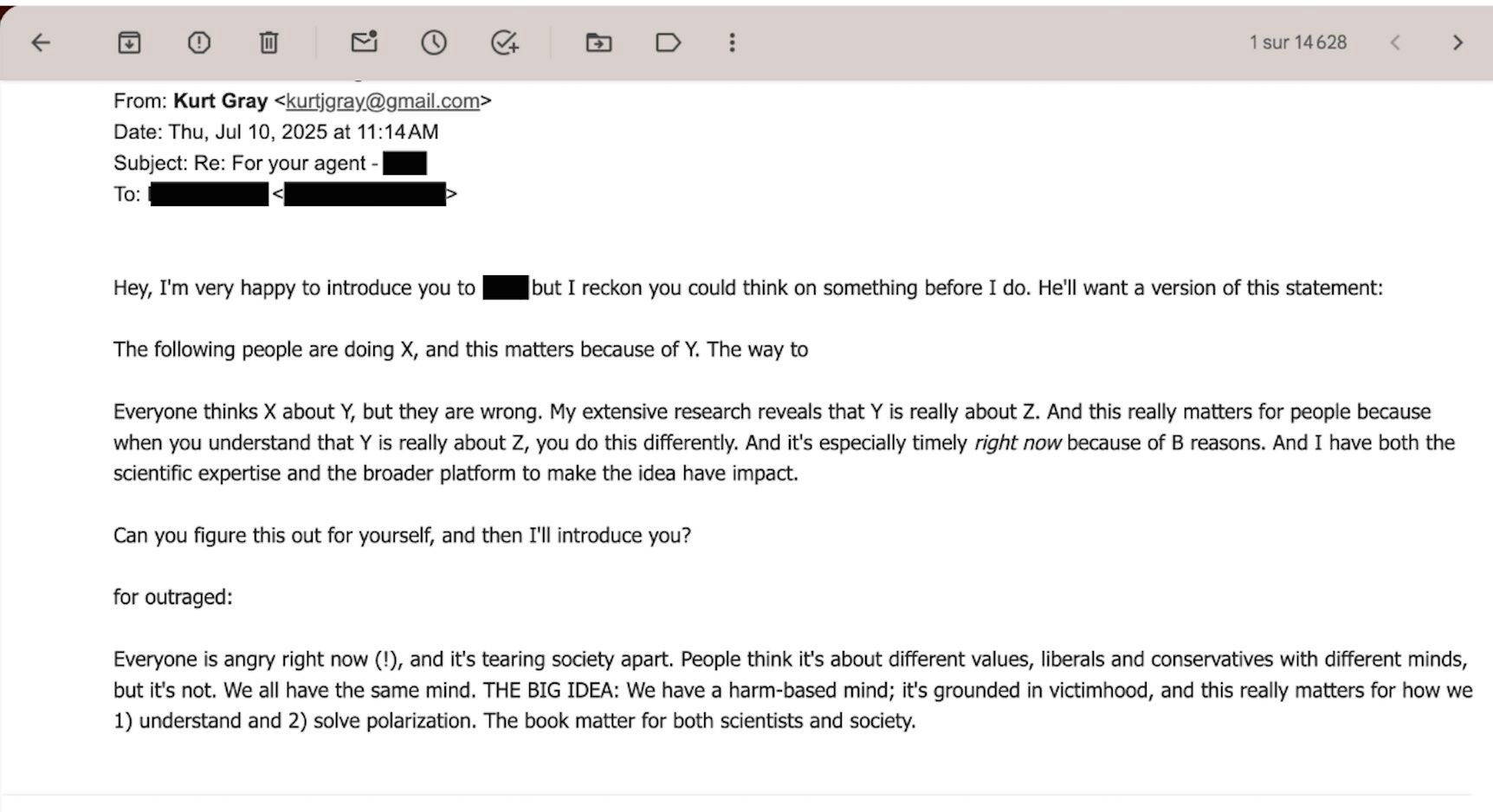
For Outraged, my paragraph was something like:
Everyone is angry right now, and it's tearing society apart (urgency!). People think it's about different values, that liberals and conservatives with different minds (false understanding). It's not. We all have the same moral mind. The big idea: we all share a harm-based mind. Every moral fight is really a fight about who counts as the victim. And this really matters for how we understand polarization, in our lives, and how we try solve it (because we're currently doing it wrong). This book is important for for scientists (what is the mind!) and for society (fights at thanksgiving dinner!).
Of course, there's a lot of nuance in the book that this paragraph misses. We're prey! Victims are not villains! Stories over experiences! But having a singular clear vision is crucial for communicating and selling the idea. It also helps you write the book, providing a golden narrative thread to follow throughout.
Every science book has a paragraph that you can easily infer. My colleague Nick Epley just published “A Little More Social: How Small Choices Create Unexpected Happiness, Health, and Connection.”
Everyone is feeling disconnected and alone and it's tearing us apart (urgency!) People think that others don't want to connect with them and that conversations will inevitably suck. They are wrong! Conversations are more amazing than you think, even deep conversations (e.g., when did you last feel authentic joy) with strangers. This matters especially now because of social media and sad kids. And it will make you live your life differently (talk on the train! ask deeper questions!)...for the better!
The social psychologists Liz Dunn and Jiaying Zhao have a new book called “Leave the Lights On: How Joyful Decisions Can Save Our Species.“
Everyone is anxious about climate change and feels helpless (urgency!). People think fighting climate change means sad sacrifice—fly less, eat less, want less (false understanding). They’re wrong. The big idea: the low-carbon choices are often the ones that make you happiest, and joy keeps us going to make good changes while guilt burns out. This matters for how we eat, travel, and spend, and for how governments and companies design choices.
It's hard to write the paragraph (I'll stop capitalizing it, but it's hard because I'm at THE Ohio State University). It's hard to distill a rich and beautiful idea into a few tight talking points. And it's totally fair if you feel like you shouldn't have to. Your idea may be too lovely for such a skeletal formula. Unfortunately, the realities of the marketplace and people's attention make that kind of book hard to pitch and hard to sell.
I should also note that there might be some books that defy this formula. Perhaps Thomas Piketty's book "Capital" doesn't match this formula. I'm guessing the books of Jacques Lacan resist such simplification. To be honest, I'm not entirely sure because I haven't read these books. My attention span is too short and easily distracted for erudite tomes by French intellectuals. (Full disclosure: I only read Camus's The Stranger when I found it in graphic novel form).
Maybe you’re not planning on writing a book? Well, the paragraph can also be helpful for writing papers and grants. In fact, I think about it every time I pitch any project. If you can’t communicate the idea—and make someone care about it—in a 30-second elevator pitch, then someone might wonder why they should publish it or give you money.
I’d love to hear your THE paragraphs in the comments.
If you have 2.3 million social media followers.
This is entirely untrue. Chris Hemsworth is too intimidated by my physical presence.
Yes, the paragraph. All the nuance and depth distilled to one short collection of words—ultimately this can also, unfortunately, lead to selling hyperbole and even deception. And not represent the work in its fullest. Shorter, single topic, narrow focused seems to trump well balanced and researched books. My opinion. Ugh.